Singapore intends to import up to 6 gigawatts (GW) of low-carbon electricity by 2035 to partly decarbonise a power sector that contributed to 40% of the country’s emissions in 2023 (EMA 2023a, EMA 2024a). While imported electricity will not fully replace local gas-fired power generation (likely for energy security reasons)1, it allows Singapore to take advantage of geographical advantages (such as sunlight, hydropower, wind, land space, et cetera) in surrounding countries to procure renewable energy.
One particularly ambitious project, the AAPowerLink led by the Australian company Sun Cable, seeks to do exactly this: draw on solar resources in Australia’s Northern Territories to produce electricity for Singapore. Yet, with huge questions surrounding its technical feasibility and cost, other environmental impacts, and other more concrete options for Singapore to import electricity, the project faces an uncertain future. Finally, for Singapore, the question of the long-term viability and impact of electricity imports in the face of political and technical uncertainty is a necessary one to ponder.
Singapore is no stranger to imports – so enter Sun Cable
Recognising the potential for electricity imports to play a part in decarbonising Singapore’s grid, Singapore has conducted two small pilot import projects to test for the feasibility of larger and longer-term agreements. First, as part of the LTMS-PIP agreement, from June 2022 to June 2024, Singapore imported 100 megawatts (MW) of power first generated through hydroelectric power plants in Laos via existing interconnections through Thailand and Malaysia. While the agreement was slated to be extended, it has since stalled due to disagreements between the latter two countries and Singapore regarding the payment structure surrounding transmission costs (Varadhan and Wongcha-um 2024). A separate pilot with Malaysia to import 100 MW from either solar or hydropower sources commenced in July 2024 (EMA n.d., Asian Power 2024, PETRA Malaysia 2024).
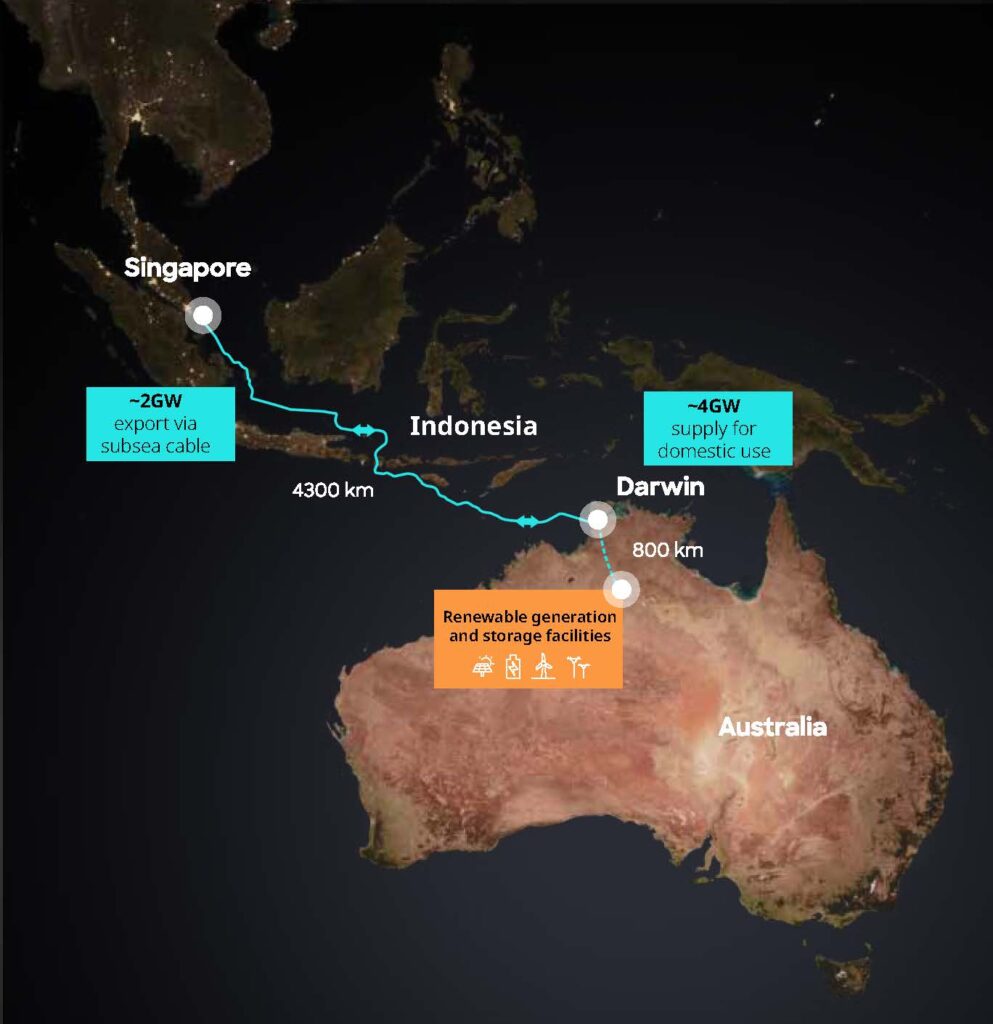
The proposed Australia-Asia Power Link (AAPowerLink) project, on the other hand, is far more ambitious in scale and intent. It would connect Darwin, Australia and Singapore via a 2 GW, 4,300km-long High Voltage Direct Current (HVDC) subsea cable that cuts through both Australian and Indonesian waters. Electricity will first be generated in a 12,000 hectare (ha), 17-20 gigawatt-peak2 (GWp) solar farm located 800km south of Darwin in Powell Creek, and sent to Darwin via overhead HVDC cables. Then, 1.75GW of solar-generated electricity on a 24/7 basis is planned to be sent to Singapore through the AAPowerLink. The solar farm would include up to 36-42 gigawatt hours (GWh) of battery storage to firm the intermittency of the solar generation.3

Notably, the project has experienced a great deal of financial and managerial turbulence. The AAPowerlink has been in discussion since 2019, was granted major project status by Australia’s federal government in July 2020, and then included in Australia’s “Infrastructure Australia Priority List” in February 2021 (SunCable 2021). It also obtained a subsea survey permit from the Indonesian government in September 2021 (Thornhill 2021), and signed a Memorandum of Understanding (MoU) with Indonesia’s Ministry of Environment and Natural Resources (MEMR) to explore greater cooperation at the G20 Summit in Bali in November 2022 (Ho 2022). Yet, barely three months after, a disagreement between billionaire investor Mike Cannon-Brookes and co-backer Andrew Forrest – fueled partly by missed deadlines and soaring costs – led the company to enter voluntary administration in January 2023, as reported by The Guardian (Hannam 2023a).
But the company has since been able to sort out some of these issues and obtain crucial approvals. In September 2023, Cannon-Brookes’ Grok Ventures injected $65 million AUD into the company, led a consortium to assume control of Sun Cable, and subsequently refreshed the company’s upper management team (SunCable 2024a; Hannam 2023b). In August 2024, the company managed to obtain environmental approval from both the Northern Territories state government and Australia’s federal government – albeit only for up to 10 GWp of solar capacity instead of the planned 17-20 GWp (SunCable 2024b; Morten and Cox 2024; SunCable 2024c). Sun Cable aims for the project to reach a final investment decision (FID) by 2027 and complete construction by 2030 (SunCable 2024b).
If all goes smoothly, the project presents a plausible option for Singapore to decarbonise its energy supply. Sun Cable would be able to supply 15.3 TWh of electricity to Singapore every year4 – representing about 14.8% of Singapore’s (high-case) projected electricity demand of 103.4 TWh in 2030 (EMA 2024b). If this 15.3 TWh were to replace gas-fired power, it can potentially avoid some 7.3 MtCO2eq of carbon emissions, or just over 27% of Singapore’s total power sector emissions in 2023 (Ember Climate 2024).5

Too ambitious, compared to more sensible alternatives
The first huge obstacle that AAPowerLink will face, however, arises from the cable itself. Due to the sheer scale and complexity of the project, there are many technical and cost-related issues that it must contend with (see also Table 1):
- Length. At the time of writing, the longest subsea HVDC cable in the world is the 1,250km long, 1.4 GW, 525 kilovolt (kV) Viking Link that connects Lincolnshire, England to Jutland, Denmark (Bellini 2023). The AAPowerLink would more than triple this length, introducing not just engineering difficulties but significant transmission losses;
- Voltage. The current maximum voltage of currently-existing subsea cables is the 385km long, 2.2GW, 600 kV UK-Western Link (SunCable n.d., Konstantinou 2019a). Sun Cable is intending to manufacture HVDC to run at a voltage of between 525kV and 640kV – the upper band would exceed that of the UK-Western Link;
- Depth. The current deepest HVDC cable in operation is the SAPEI cable connecting Latina, Italy to the island of Sardinia at 1.65km, while the deepest trench between Darwin and Java would likely reach 2km (Konstantinou 2019b); and
- Cost. The capital expenditure (Capex) necessary for subsea HVDC cables is highest compared to its above-ground or underground counterparts, due to additional boosters and material costs required to maintain the voltage for Singaporean users and protect against deterioration and weathering (Hannam 2023c, Patonia et al. 2023).

In all – there is no precedent for the technical viability of the proposed subsea cable at the proposed length, voltage, and depth. And even if these can become commercially viable, the capital costs for the cable will likely be sky-high (Patonia et al. 2023).6 Moreover, as with all subsea cables, AAPowerLink is likely to pose a slew of environmental impacts to marine environments through the creation of electromagnetic fields and artificial reefs (Taormina et al. 2018). The cable would furthermore pass through the habitats and migratory routes of endangered marine animals like turtles, dugongs, pygmy blue whales and whale sharks, necessitating extensive care during installation and maintenance (Taormina et al. 2018, Gibson 2022). The combination of uncertainties could explain why Singapore has not signed any agreement or MoU to formally ratify the project at any point since 2019, rendering any official offtaking uncertain.

Singapore, moreover, already intends to procure renewable electricity from other sources closer to home. The EMA has already issued five conditional licences to import 2 GW of renewable electricity7 from Indonesia, and four conditional approvals to import a further 3.6 GW from Indonesia, Cambodia, and Vietnam (Begum and Baharudin 2024). These projects must be able to achieve a 75% quarterly load factor five years after the commissioning of the projects, according to the EMA (EMA 2023b, EMA 2023c) – this comes up to some 36.8 TWh of total imported energy per year.8 Combined with the existing 100 MW from the LTMS-PIP and the intended 200 MW from Malaysia9 (Begum and Baharudin 2024), these agreements would already hit Singapore’s 6 GW target.

Also, considering Capex outlay alone, importing from Cambodia and Vietnam would logically cost less as they would likely utilise existing overhead transmission cables. The Indonesian projects,10 on the other hand, would necessitate the building of subsea power cables that do not yet exist between Singapore and the Riau Islands (where the solar farms that supply the energy will be built). But these cables would certainly be far shorter, and therefore more straightforward to assess, approve, and build. So, unless Sun Cable can sell Singapore power at an “ultra-low” price (Hannam 2023c) – something that is yet to be proven – Singapore probably will not see the need to take on the far higher-risk option.
If Singapore will not be the eventual offtaker, where does it then leave Sun Cable? It could, for one, sell its electricity internally within Australia (Hannam 2023c). But if it is insistent on building that subsea cable, then perhaps a more straightforward solution would be to sell the electricity to Indonesia instead. Having already signed an MoU with Indonesia in 2022, the path forward for Sun Cable might be less-ridden with difficulty. For one, the cables from Darwin to Bali (the easternmost end of the Java-Madura-Bali grid where electricity demand is highest) would certainly be far shorter.11
Imports a direct path to decarbonisation now but long-term sustained impact is uncertain
The AAPowerLink is a prime example of a huge infrastructure undertaking that, if realised, will certainly open up significant new paradigms for long distance subsea electricity transmission both for Singapore, and globally too. Yet, until then, it remains a technically challenging and expensive dream to realise the dream of an interconnected extra-ASEAN grid, in the face of far more easy-to-capture alternatives that make more technical and practical sense. Considering this, electricity imports from neighbouring Southeast Asian countries are – in the author’s opinion – the most straightforward way to partly decarbonise Singapore’s grid. After all, the transmission infrastructure already exists to some degree, and Singapore’s ASEAN neighbours have largely committed to increasing renewable generation capacity in the next decade (Safrina et al. 2023).
But as is the case in the now-stalled LTMS-PIP, the political uncertainty is always in play, where prior agreements might not be extended due to each participating country’s own developmental aims. Moreover, very real technical challenges are present in the countries seeking to export energy to Singapore. Consider, for instance, the case where many solar operators in Vietnam were faced with curtailment after the solar boom in 2019-20 as the country’s transmission network simply could not handle peak generation spikes (Le 2022). Unless the internal grids within ASEAN countries can expand to keep up with planned capacity increases, Singapore surely cannot be completely certain that renewable energy can be reliably procured.

Finally, there is the question of what kind of decarbonisation electricity imports actually confer for Singapore. If new-build power cables stretch from solar or wind farms to feed the generated electrons directly into Singapore (like those that will need to be built from Riau to Singapore), then all is well and good. But as it stands, documentation on whether the actual generated green electrons are, and will be, actually brought into Singapore via existing interconnections is unclear (Chen 2024). A coordinated manner of recording and trading renewable energy certificates (RECs) between participating countries could help in accurately tracking electron flows to ensure no double-counting, but the additionality of RECs (i.e., evidence that renewable energy would not have been generated without the REC) has been itself called into question (Bjørn et al. 2022).
For electricity imports to truly help Singapore achieve its emission reduction goals, there is thus an intrinsic need to either refine accounting methods, or to work to ensure that green electrons directly reach Singapore’s shores. So maybe Sun Cable has the correct intention after all – but sometimes, the distance between expectation and reality is literally too large.
Written by Nicholas Loh. All views are my own. Special thanks to Ernest Lee for edits and comments.
Footnotes
- The EMA intends to further increase the capacity of gas-fired power generation. In June 2024, the EMA released a Request For Proposal (RFP) for two new 600 MW gas-fired power plants (that will be 30% ‘hydrogen-ready’), to be completed in 2029 and 2030 respectively (EMA 2024b). ↩︎
- Although it is often conflated, it is important to make the distinction between GWp and GW when referring to solar generation. GWp ratings refer to the “direct current (DC) capacity of a solar PV module at maximum output under standard test conditions” (Yu 2021). GW ratings refer to the amount of power that the solar plant can reliably deliver to the grid, which is generally limited by the capacity of inverters that these plants must be coupled with to transmit generated electricity to the grid (Wiki-Solar Glossary 2013). ↩︎
- Solar energy is considered to be intermittent because of the simple fact that the sun does not always shine. Simply put, battery storage can help to smooth out this intermittency over a few hours by charging when generation is high (i.e., when the sun is shining) and discharging when generation is low (i.e., when the sun sets, or if it is cloudy). With batteries, solar-generated energy can be readily discharged at any time of day, especially at night when load demands are generally higher. ↩︎
- The 15.3 TWh figure is calculated by multiplying the 1.75 GW of power by the number of hours in a year (8,760). ↩︎
- This 7.3 MtCO2eq figure is obtained by assuming the emissions intensity from Singapore gas generation in 2023, obtained from data from Ember (2024). ↩︎
- Considering current technology, subsea HVDC cables are the most expensive cable type at around 600-650 EUR/MW/km in initial Capex, compared to above- (~490-590 EUR/MW/km) or underground HVDC (~510-620 EUR/MW/km) cables, according to analysis by Patonia et al. (2023). The technological and technical complexity of the proposed AAPowerLink would likely result in an increase in the required Capex. ↩︎
- A mix of solar, wind, and hydropower. ↩︎
- For instance, in a quarter of 92 calendar days, a project that secures a licence to import 1 GW of energy will need to reliably send 1.66 TWh (1 GW * 92 calendar days in a quarter * 24 hours per day * 75% load factor) of electricity to Singapore. ↩︎
- To maximise the use of the interconnections, the required quarterly load factor for the Malaysian imports is 90% instead of 75% (EMA 2021). ↩︎
- Of note, companies like Sunseap and Vena Energy plan to build gigawatt-scale solar farms in the Riau Islands of Indonesia with the eventual aim of exporting solar power to Singapore (EDP Renewables 2022, Vena Energy 2023). The EMA has awarded the Vena Energy project (2 GW solar with 8 GWh of battery storage) a conditional approval to export 0.4 GW of power to Singapore (Vena Energy 2024). ↩︎
- Due to poor interconnections between Indonesia’s grid systems, and that most solar projects are being built in the surrounding islands like Kalimantan, Sulawesi, and Papua (PT PLN 2021), the Java-Madura-Bali grid that exerts the most demand is also the most reliant on coal-fired power. For more on Indonesia’s power industry and why coal is so entrenched, refer to our previous article, here. ↩︎
Bibliography and References
Asian Power. 2024. ‘Sustainability of Malaysia’s ENEGEM hinges on renewable energy growth’. July 2024. https://asian-power.com/ipp/exclusive/sustainability-malaysias-enegem-hinges-renewable-energy-growth.
Begum, Shabana, and Hariz Baharudin. 2024. ‘Singapore Accelerates Drive to Import Low-Carbon Electricity, Raising Target from 4GW to 6GW by 2035’. The Straits Times, 6 September 2024. https://www.straitstimes.com/singapore/s-pore-accelerates-drive-to-import-low-carbon-electricity-upping-target-from-4gw-to-6gw-by-2035.
Bellini, Emiliano. 2023. ‘Prysmian Completes World’s Longest Subsea Interconnector’. PV Magazine International. 4 September 2023. https://www.pv-magazine.com/2023/09/04/prysmian-completes-worlds-longest-subsea-interconnector/.
Bjørn, Anders, Shannon M. Lloyd, Matthew Brander, and H. Damon Matthews. 2022. ‘Renewable Energy Certificates Threaten the Integrity of Corporate Science-Based Targets’. Nature Climate Change 12 (June): 539–46. https://doi.org/10.1038/s41558-022-01379-5.
Chen, Linus. 2024. ‘Lao hydropower exports to Singapore: The hidden costs behind ASEAN’s “sustainable energy” promise’. Sciences Po Energy Review, Energy Transitions: Narratives and Sequencing, 1: 75-81. https://www.sciencespo.fr/psia/chair-sustainable-development/wp-content/uploads/2024/07/sciencespo-chair-sustainable-development-energy-review-issue-1.pdf.
Borsboom-Hanson, Tory, Shashank Reddy Patlolla, Omar E. Herrera, and Walter Mérida. 2022. ‘Point-to-Point Transportation: The Economics of Hydrogen Export’. International Journal of Hydrogen Energy, GCGW-21 – Global Warming Reduction by Hydrogen, 47 (74): 31541–50.
EDP Renewables. 2022. ‘Sunseap Signs MOU with Riau Islands for Large-Scale Solar Energy and Storage Plants’. Media release. 19 April 2022. https://www.edpr.com/apac/en/news/sunseap-signs-mou-riau-islands-large-scale-solar-energy-and-storage-plants.
Ember Climate. 2024. “Electricity Data Explorer.” https://ember-climate.org/data/data-tools/data-explorer/.
Energy Market Authority. 2021. ‘REQUEST FOR PROPOSAL TO APPOINT ELECTRICITY IMPORTER TO IMPORT 100MW VIA THE EXISTING SINGAPORE-PENINSULAR MALAYSIA INTERCONNECTOR FOR A 2-YEAR TRIAL’. Proposal. 5 March 2021. https://www.ema.gov.sg/content/dam/corporate/partnerships/proposals/request-for-proposal-to-appoint-electricity-importer-to-import-100mw-via-existing-singapore-peninsular-malaysia-interconnector/EMA-Partnerships-Calls-for-Proposals-RFP-Appoint-Electricity-Importer-Singapore-Peninsular-Malaysia-Interconnector.pdf.coredownload.pdf
Energy Market Authority. 2023a. ‘Emission Standards for Power Generation Units’. https://www.ema.gov.sg/partnerships/consultations/2023/emission-standards-for-power-generation-units.
Energy Market Authority. 2023b. ‘FIRST REQUEST FOR PROPOSAL (RFP1) TO APPOINT LICENSED ELECTRICITY IMPORTERS (WITH REFERENCES TO RFP2)’. Proposal. 1 August 2023. https://www.ema.gov.sg/content/dam/corporate/partnerships/proposals/first-request-for-proposal-to-appoint-licensed-electricity-importers/RFP1-Document-caa-1-Aug-2023.pdf.coredownload.pdf.
Energy Market Authority. 2023c. ‘SECOND REQUEST FOR PROPOSAL (RFP2) TO APPOINT LICENSED ELECTRICITY IMPORTERS’. Proposal. 1 August 2023. https://www.ema.gov.sg/content/dam/corporate/partnerships/proposals/second-rfp2-to-appoint-licensed-electricity-imports/RFP2-Document-1-Aug-2023.pdf.coredownload.pdf.
Energy Market Authority. 2024a. ’Singapore and Indonesia Make Substantive Progress on Electricity Imports’. Media release. 5 September 2024. https://www.ema.gov.sg/news-events/news/media-releases/2024/singapore-indonesia-make-substantive-progress-on-electricity-imports.
Energy Market Authority. 2024b. ‘EMA Launches Second Request for Proposal for New Generation Capacity to Meet Growing Electricity Demand’. Media release. 4 June 2024. https://www.ema.gov.sg/news-events/news/media-releases/2024/ema-launches-second-rfp-for-new-generation-capacity-to-meet-growing-electricity-demand.
Energy Market Authority. n.d. ‘Regional Power Grids’. https://www.ema.gov.sg/our-energy-story/energy-supply/regional-power-grids.
Gibson, Jano. 2022. ‘Environmental Impact Statement Released for Sun Cable’s $30 Billion Solar Energy Project’. ABC News, 20 April 2022. https://www.abc.net.au/news/2022-04-20/environmental-impact-sun-cable-northern-territory/101001042.
Hannam, Peter. 2023a. ‘“Billionaire Biffo” Shines Light on Hugely Ambitious $30bn Sun Cable Solar Project’. The Guardian, 12 January 2023, sec. Environment. https://www.theguardian.com/environment/2023/jan/12/billionaire-biffo-shines-light-on-hugely-ambitious-30bn-solar-project.
Hannam, Peter. 2023b. ‘Giant Solar Farm Project in Doubt after Disagreement between Mike Cannon-Brookes and Andrew Forrest’. The Guardian, 11 January 2023, sec. Environment. https://www.theguardian.com/environment/2023/jan/11/giant-solar-farm-project-in-doubt-after-disagreement-between-mike-cannon-brookes-and-andrew-forrest.
Hannam, Peter. 2023c. ‘Sun Cable: Mike Cannon-Brookes Takes Charge of “World-Changing” Solar Project’. The Guardian, 7 September 2023, sec. Environment. https://www.theguardian.com/environment/2023/sep/07/sun-cable-mike-cannon-brookes-takes-charge-of-world-changing-solar-project.
Ho, Jovi. 2022. ‘Sun Cable Signs MOU with Indonesia’s Energy Ministry at G20 Business Summit’. Yahoo Finance, 17 November 2022. https://sg.finance.yahoo.com/news/sun-cable-signs-mou-indonesias-200531679.html.
Konstantinou, Georges. 2019a. ‘AU – ASEAN Projects and the Current HVDC Scene’. Blog of the Real-Time Digital Simulation Laboratory at UNSW Sydney (blog), 7 August 2019. https://rtsunsw.home.blog/2019/07/29/au-asean-projects-and-the-current-hvdc-scene/.
Konstantinou, Georges. 2019b. ‘Cable News’. Blog of the Real-Time Digital Simulation Laboratory at UNSW Sydney (blog), 2 August 2019. https://rtsunsw.home.blog/2019/08/02/cable-news/.
Le, Lam. 2022. ‘After Renewables Frenzy, Vietnam’s Solar Energy Goes to Waste’. Al Jazeera, 18 May 2022. https://www.aljazeera.com/economy/2022/5/18/after-renewables-push-vietnam-has-too-much-energy-to-handle.
Morton, Adam, and Lisa Cox. n.d. ‘Huge NT Solar Farm Backed by Mike Cannon-Brookes Gets Environmental Approval’. The Guardian. https://www.theguardian.com/environment/article/2024/aug/21/suncable-solar-farm-nt-approved.
NKT. n.d. ‘NordBalt, The Baltic Sea’. https://www.nkt.com/references/nordbalt-the-baltic-sea.
Patonia, Aliaksei, Veronika Lenivova, Rahmat Poudineh, and Christoph Nolden. 2023. ‘Hydrogen Pipelines vs. HVDC Lines: Should We Transfer Green Molecules or Electrons?’ Oxford Institute for Energy Studies. https://www.oxfordenergy.org/publications/hydrogen-pipelines-vs-hvdc-lines-should-we-transfer-green-molecules-or-electrons/.
PETRA Malaysia. 2024. ‘ENERGY EXCHANGE MALAYSIA (ENEGEM) ESTABLISED FOR CROSS-BORDER SALES OF GREEN ELECTRICITY TO SINGAPORE’. Media release. 15 April 2024. https://www.st.gov.my/contents/files/press/nocategory/2024-04-15/MS_Bil.13_2024_ENERGY%20EXCHANGE%20MALAYSIA%20%28ENEGEM%29%20ESTABLISED%20FOR%20CROSS-BORDER%20SALES%20OF%20GREEN%20ELECTRICITY%20TO%20SINGAPORE.pdf.
PT Perusahaan Listrik Negara. 2021. “Rencana Usaha Penyediaan Tenaga Listrik (RUPTL) 2021-2030.” 28 September 2021. https://web.pln.co.id/statics/uploads/2021/10/ruptl-2021-2030.pdf.
Safrina, Rika, Ambiyah Abdullah, Ghiffari Aby Malik Nasution, Silvira Ayu Rosalia, Diah Retno Yuniarni, and Amira Bilqis. 2023. ‘Outlook on ASEAN Energy 2023: Key insights about ASEAN Energy Landscape and Trends in 2023’. Asean Centre for Energy. https://asean.org/wp-content/uploads/2023/04/Outlook-on-ASEAN-Energy-2023.pdf.
SunCable. 2021. ‘Australia-ASEAN Power Link: Creating an Asia renewable energy hub in Singapore’. Presentation at ASEAN Energy & Utilities Digital Week. 6 July 2021. https://www.asew-expo.com/AEUDW2021/download/Indonesia-Nusantara-Renewable-Grid/Presentation_How_Sun_Cable.pdf.
SunCable. 2024a. ‘SunCable Strengthens Senior Leadership Team’. Media release. 30 January 2024. https://www.suncable.energy/news/suncable-strengthens-senior-leadership-team.
SunCable. 2024b. ‘SunCable’s Flagship AAPowerLink Project Receives Major Environmental Approval’. Media release. 16 July 2024. https://www.suncable.energy/news/suncables-flagship-aapowerlink-project-receives-major-environmental-approval.
SunCable. 2024c. ‘SunCable Receives Major Commonwealth Government Environmental Approval for Flagship Project’. Media release. 21 August 2024. https://www.suncable.energy/news/suncable-receives-major-commonwealth-government-environmental-approval-for-flagship-project.
SunCable. n.d. ‘SunCable Manufacturing’. https://www.suncable.energy/manufacturing.
Taormina, Bastien, Juan Bald, Andrew Want, Gérard Thouzeau, Morgane Lejart, Nicolas Desroy, and Antoine Carlier. 2018. ‘A Review of Potential Impacts of Submarine Power Cables on the Marine Environment: Knowledge Gaps, Recommendations and Future Directions’. Renewable and Sustainable Energy Reviews 96 (November):380–91.
Thornhill, James. 2021. ‘Solar Power Export Bid From Australia to Singapore Clears Hurdle – Bloomberg’. Bloomberg. 3 September 2021. https://www.bloomberg.com/news/articles/2021-09-23/outback-to-singapore-solar-power-bid-clears-indonesia-hurdle.
Varadhan, Sudarshan, and Panu Wongcha-um. n.d. ‘Exclusive: Singapore-Laos Clean Power Deal Stuck over Transmission, Sources Say’. Reuters. https://www.reuters.com/business/energy/singapore-laos-clean-power-deal-stuck-over-transmission-sources-say-2024-07-17/.
Vena Energy. 2023. ‘Vena Energy Signs Landmark Framework Agreement With Suntech, Powin, and REPT Battero to Explore Expansion of Indonesia’s Renewable Energy Supply Chain’. Media release. 7 August 2023. https://www.venaenergy.com/news/vena-energy-signs-landmark-framework-agreement-with-suntech-powin-and-rept-battero-to-explore-expansion-of-indonesias-renewable-energy-supply-chain/.
Vena Energy. 2024. ‘Vena Energy Receives EMA’s Conditional Approval to Export 400MW of Solar Power from Riau Islands, Indonesia to Singapore’. Media release. 5 September 2024. https://www.venaenergy.com/news/vena-energy-receives-emas-conditional-approval-to-export-400mw-of-solar-power-from-riau-islands-indonesia-to-singapore/.
Wiki-Solar Glossary. 2013’. Capacity rating for solar generating stations: What is a megawatt?’ Explainer paper. July 2013. https://wiki-solar.org/library/papers/WSG01-01_Capacity.pdf.
Wikipedia. n.d. ’Submarine power cable’. Wikimedia Foundation. https://en.wikipedia.org/wiki/Submarine_power_cable.
Wikipedia. n.d. ’Basslink’. Wikimedia Foundation. https://en.wikipedia.org/wiki/Basslink.
Wikipedia. n.d. ’North Sea Link’. Wikimedia Foundation. https://en.wikipedia.org/wiki/North_Sea_Link.
Yu, Pei-Hua. 2021. ‘What Does 1 GW of Installed Solar Energy Mean? How Many Houses Can It Power?’ Medium (blog). 27 January 2021. https://peihuayu.medium.com/what-does-1-gw-of-installed-solar-energy-mean-how-many-houses-can-it-power-bb32ea6cc19.